
In college, I was tasked to present the Chinese dynasties. Since then, the history of China has been a fascinating topic to me.
It built the Great Wall, the Terracotta Army, the Forbidden City, and more. The country is facing controversies, but we can’t deny that it has wonders.
The Great Wall began as separate fortifications in the 7th century BCE and was first unified under the Qin Dynasty.
A dynasty simply means a family or group that rules for many years. When one dynasty loses power, another dynasty rises and takes over.
This cycle happened again and again in China for thousands of years, since its first civilization was established along the Yellow River.
The timeline from Xia to Qing gives us a clear picture of how it developed into one of the world’s most advanced civilizations.
Chinese Dynasties Ruled China From Around 2070 BCE to 1912
Chinese dynasties had existed from around 2070 BCE until 1912 of the common era. Very few civilizations kept a continuous cultural identity for that long, so China’s history is one of the most impressive in world history.
Many things we associate with it today, such as the Great Wall, Confucianism, silk, paper, and porcelain, were created during the dynasty era.
Chinese Dynasties Complete Timeline From Xia to Qing
When one dynasty collapsed, another one stepped in and rebuilt the country. This cycle helped China survive for thousands of years.
The last dynasty under Puyi ended in 1912. Let us go through the Chinese dynasties complete timeline from Xia to Qing.
Xia Dynasty (2070–1600 BCE)
The Xia Dynasty is not as well‑documented as later dynasties. Some parts of its story come from ancient legends, but many historians believe it existed because archaeological sites match the descriptions.
It formed when early Chinese communities began organizing themselves into larger groups and united under one leader so that they could manage natural disasters, protect themselves from invaders, and grow more food.
They used bronze tools, had proto‑writing symbols, and practiced agriculture. Later dynasties believed that they established early models of kingship.

Shang Dynasty (1600–1046 BCE)
The Shang Dynasty is the first dynasty with strong archaeological evidence.
Its people developed advanced bronze tools, weapons, and artwork. They also created one of the earliest known writing systems in China, found on oracle bones used for fortune‑telling.
The kings ruled from walled cities and controlled surrounding lands. Eventually, however, they became corrupt and harsh. Heavy taxes, forced labor, and constant warfare weakened the dynasty.
In ancient China, rulers of the Shang and Zhou were called kings. The title “emperor” was invented later by Qin Shi Huang.
When King Wu of the Zhou clan defeated King Zhou, who was the last Shang king, at the Battle of Muye in 1046 BCE, he established the Zhou Dynasty.
Zhou Dynasty (1046–256 BCE)
The Zhou Dynasty was the longest dynasty in Chinese history.
It introduced the “Mandate of Heaven,” which is the idea that rulers must govern fairly or lose the right to rule.
It also developed a feudal system where nobles controlled land in exchange for loyalty, but it weakened when nobles became too powerful.
The Zhou period is divided into two parts: the Western Zhou, which was peaceful and stable, and the Eastern Zhou, which included the Spring and Autumn Period and the Warring States Period.
During the Eastern Zhou, many small states fought for power, but this time also produced Confucius, Laozi, and Mencius.
Eventually, the Qin state conquered all six rival Warring States, and by doing so ended the Zhou Dynasty and unified China.
Qin Dynasty (221–206 BCE)
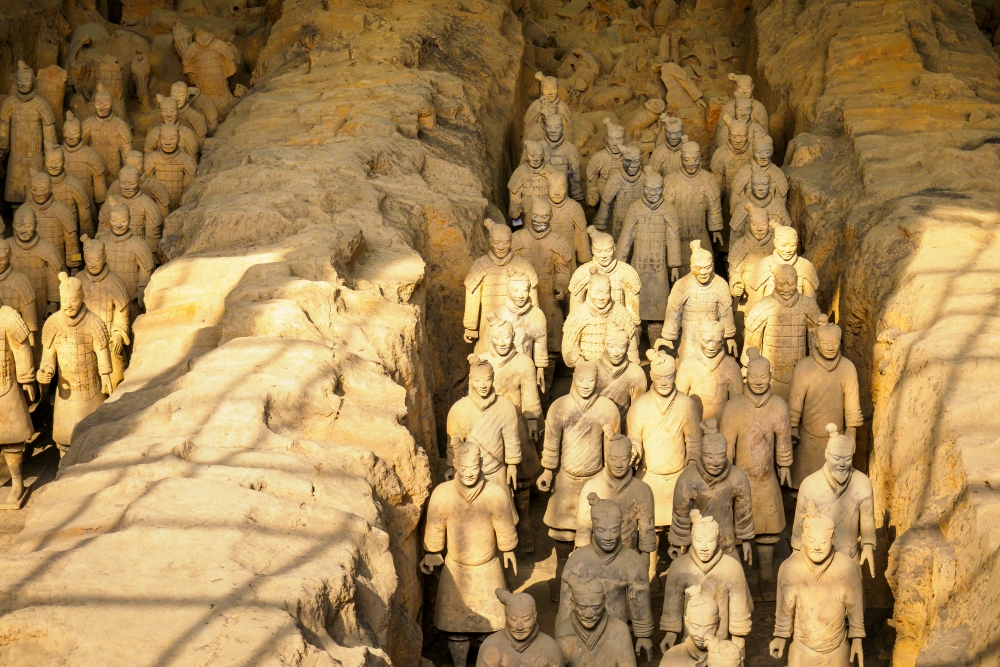
The Qin Dynasty was short but extremely important. It was the first dynasty to unify China under one emperor, Qin Shi Huang.
He standardized writing, money, weights, and measurements so that the whole country could communicate and trade more easily.
He also used legalism, which helped him unify China quickly, but people were unhappy. He was strict and used harsh laws to control.
The first version of the Great Wall and the famous Terracotta Army, which are now popular tourist spots, were built during his time.
After his death, the dynasty ended. It was short, but it created the foundation for a unified Chinese state and influenced future dynasties.
The name “China” even came from “Qin.”
Han Dynasty (206 BCE–220)
The Han Dynasty is one of China’s greatest golden ages. Many Chinese people today call themselves “Han Chinese” because it influenced the country’s culture, identity, and traditions more than any other dynasty.
It improved government by using Confucian teachings; it created civil service exams so that officials were chosen based on ability, not family background.
The Han Dynasty civil service exam covered Confucian classics, ethical governance, administrative skills, and moral character.
It also expanded China’s borders and opened the Silk Road, which connected it to the Middle East and Europe to trade silk, spices, and even ideas.
When it collapsed due to corruption, high taxes, and rebellions, it entered a long period of division that eventually led to the Six Dynasties period.
Six Dynasties (220–589)
After the Han Dynasty fell, no single group could control the country. Instead, different kingdoms ruled different regions, including the Three Kingdoms, Jin Dynasty, and the Northern and Southern Dynasties.
The constant fighting made life difficult for many people, so they moved to other places, mostly in the south, to escape the chaos.
Nonetheless, this era saw important cultural growth. Buddhism spread widely in China, bringing new ideas about life, suffering, and peace.
Art and poetry also developed unique styles, and scholars continued writing.
This period ended in 589 when the Sui Dynasty defeated the Chen Dynasty, the last of the Southern Dynasties, and finally reunited China after more than three centuries of division.


Sui Dynasty (581–618)
The Sui Dynasty reunited China after the Six Dynasties period. It created a strong central government, fixed laws, and improved the tax system.
Its biggest achievement was building the Grand Canal, a massive waterway connecting northern and southern China, which helped move food, goods, and soldiers quickly across the empire.
It also repaired the Great Wall and improved roads.
It had many projects that strengthened the country, but those required heavy taxes and forced labor, which made people angry.
Emperor Yang, the last Sui emperor, became unpopular because of constant wars and expensive construction.
So, rebellions broke out, and the dynasty collapsed.
Tang Dynasty (618–907)
The Tang Dynasty was a golden age of Chinese culture.
Li Bai, Du Fu, and more poets emerged. Women also had more freedom compared to earlier periods, and society was lively and diverse.
However, it eventually weakened due to corruption, military problems, and rebellions, including the An Lushan Rebellion, which caused massive destruction and reduced the empire’s strength.
When the Tang Dynasty fell, it led to another period of division called the Five Dynasties, during which five short‑lived northern dynasties rose and fell in rapid succession, while southern kingdoms ruled independently.
Five Dynasties (907–960)
The Five Dynasties period was a short but chaotic time after the Tang Dynasty in northern China, which saw five different dynasties rise and fall quickly
It happened at the same time as southern China’s Ten Kingdoms, which were generally more peaceful and wealthier because they could focus on trade, agriculture, and local development instead of constant warfare.
It was unstable, but it contributed to Chinese culture. Artists developed new painting styles, like landscape painting. Scholars continued writing.
It ended when the Song Dynasty finally reunited most of China.
Song Dynasty (960–1279)
The Northern Song and the Southern Song were two phases of the Song Dynasty, divided because the north was conquered by foreign powers in 1127.
The government improved education and expanded the civil service exam system. Inventions also flourished at this time, including gunpowder, movable‑type printing, and the magnetic compass.
However, its military was weaker than its neighbors. Northern invaders forced it to move south, and later the Mongols conquered the entire dynasty.
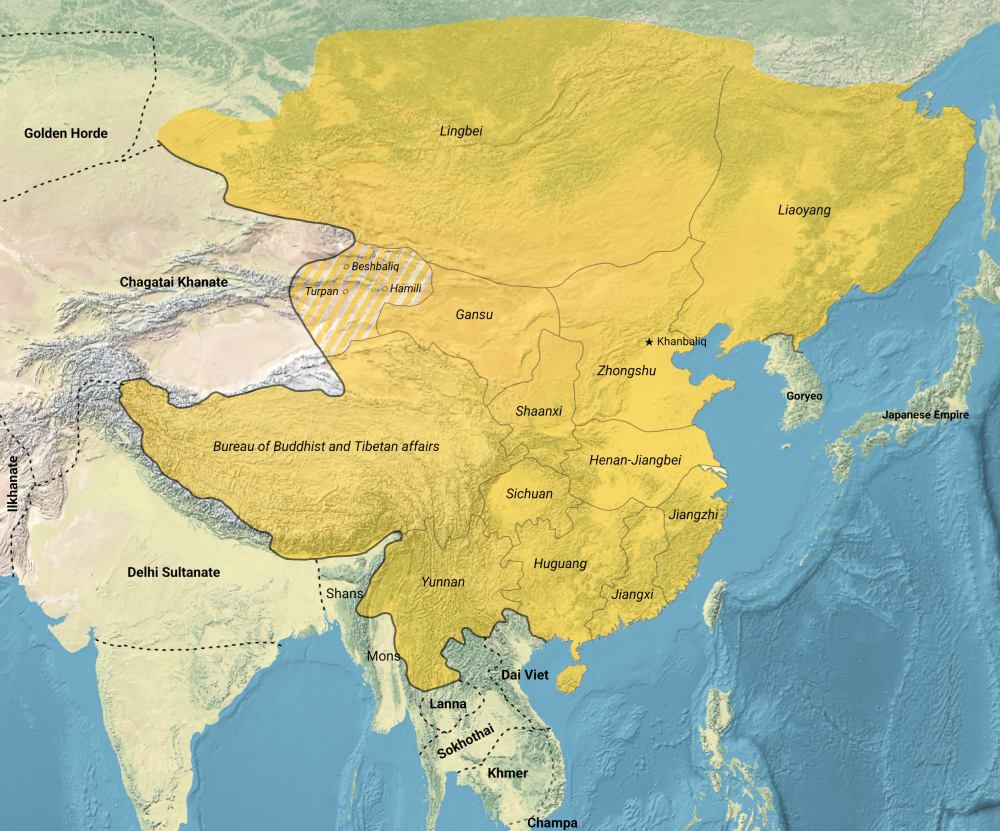
Yuan Dynasty (1271–1368)
The Yuan Dynasty was founded by Kublai Khan, a Mongol and grandson of Genghis Khan. It was the first time China was ruled by a foreign group.
The Mongols created a large empire that connected China to Central Asia, the Middle East, and Europe. This made trade and cultural exchange easier.
Marco Polo visited China at this period and wrote about the country’s wealth, advanced technology, and bustling cities in his book called The Travels of Marco Polo.
However, they treated Chinese people differently and placed themselves at the top of society. Heavy taxes and corruption caused people to rebel.
Eventually, it collapsed, and the Ming Dynasty took over.
Ming Dynasty (1368–1644)
The Ming Dynasty restored Chinese rule after the Mongols.
Its emperors rebuilt parts of the Great Wall and constructed the Forbidden City, a massive palace complex for the emperor located in Beijing.
During this time, Admiral Zheng He led voyages across Southeast Asia, India, and Africa to show off China’s power and wealth through his massive fleets.
However, the dynasty eventually faced problems like corruption, high taxes, and peasant rebellions, similar to earlier dynasties.
The Manchus invaded and ended the Ming Dynasty.
Qing Dynasty (1644–1912)
The Qing Dynasty was China’s last imperial dynasty. It was founded by the Manchus, a group from the northeast. It expanded the country’s territory to its largest size, ruling over many different ethnic groups.
Early emperors, such as Emperor Kangxi and Emperor Qianlong, brought stability, economic growth, and cultural development.
However, China was forced to sign unequal treaties after the Opium Wars. Rebellions, like the Taiping Rebellion, caused massive destruction. The government struggled to modernize. Corruption weakened the dynasty.
By the early 1900s, many Chinese people wanted reform and a new political system. The dynasty eventually collapsed in 1912.

The Xinhai Revolution Ended the Chinese Dynasties
Many Chinese were unhappy with the Qing government because it failed to modernize, lost wars to foreign powers, and allowed corruption to grow.
So, they organized and revolted against it.
The Xinhai Revolution, which lasted from 1911 to 1912, ended the imperial rule and replaced the Qing dynasty with a republic.
Mostly students, soldiers, merchants, and reform‑minded intellectuals joined the Xinhai Revolution.
The last Qing emperor, Puyi, who was only a child, stepped down in 1912.
The Republic of China Replaced the Qing Dynasty
After the Qing Dynasty fell in 1912, the Republic of China was established, with Sun Yat‑sen as the first provisional president.
When he died in 1925, Chiang Kai-shek replaced him and ruled until 1949, when the Nationalists lost the Chinese Civil War and retreated to Taiwan.
The republic struggled because China was still divided. Different military leaders controlled different regions. Foreign powers also continued to influence the country, which caused frustration among the people.
The Republic of China Moved to Taiwan After the Chinese Civil War
The Chinese Civil War was fought between the Nationalists, which Sun Yat-sen and Chiang Kai-shek were part of, and the Communists from 1927 to 1949.
The conflict began because both sides wanted to control China but had very different ideas about how it should be governed: the Nationalists wanted a republic, while the Communists wanted a socialist.
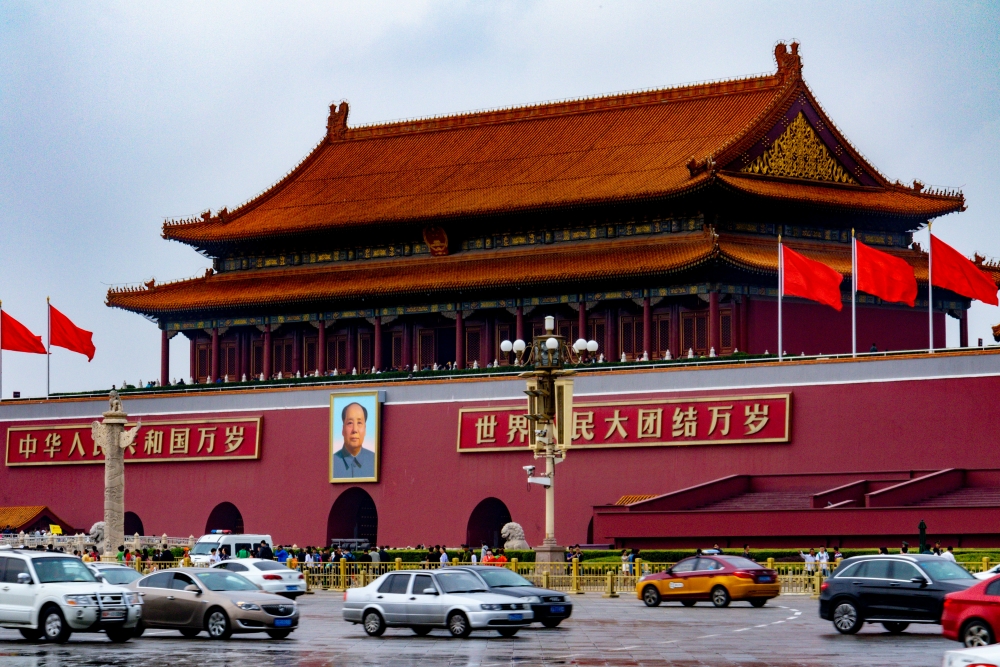
In 1949, the Communists won control of mainland China and established the People’s Republic of China (PRC).
The Nationalists, on the other hand, retreated to Taiwan, where it continued to call itself the Republic of China (ROC).
This explains why there are two political entities that both trace their roots to historical China, and why the One‑China Policy exists today, with different interpretations about which government represents it.