
René Descartes was the proponent of “I think, therefore I am.” It means that thinking is the starting point of certainty.
He wanted people to question assumptions and search for evidence. We shouldn’t believe ideas just because others said they were true; we must examine our own thoughts and verify.
This opened the door for scientific discoveries, logical problem‑solving, and a more independent way of understanding reality.
Let us explore his ideas and his influence on the sciences.
René Descartes Said, “I Think, Therefore I Am”
When Descartes said, “I think, therefore I am,” he was trying to find one thing that couldn’t be doubted. He realized that even if he questioned everything, he couldn’t doubt the fact that he was thinking.
The very act of doubting proved that a thinking mind existed. It was his starting point for rebuilding knowledge from something absolutely certain.
Descartes believed that if we want to understand the truth, we must begin with something that can’t be questioned. For him, it was the existence of the thinking self.
It also shifted attention inward, toward the mind, making personal reasoning more important than what people say or what tradition dictates.
“I think, therefore I am” is still widely quoted because it captures a powerful idea: Our ability to think is proof that we exist as a conscious being.
The Self Is the Starting Point of Knowledge
Our senses can deceive us. Memories can be unclear. People can be mistaken. But the awareness of our own thoughts is undeniable.
This is why Descartes argued that the self, or the thinking mind, is the most reliable foundation for knowledge. Before we can understand the world, we must first understand how we think.
We must be aware of our assumptions, question our beliefs, and make sure that our ideas are based on clear reasoning.
The journey to truth begins inside the mind, with the thinker.

Important Ideas of René Descartes
Descartes is the Father of Modern Philosophy and Analytic Geometry. His ideas focused on finding true knowledge and, in mathematics, determining the exact sizes and relationships of shapes using algebra.
Reason Is the Primary Source of Knowledge
Descartes argued that the senses can be fooled, so we must use our minds actively and look for rational explanations.
Rationalism is the belief that knowledge comes mainly from clear thinking and reason, not from experience.
If an idea is clear and distinct, meaning it makes perfect sense and can’t be doubted, then it can be accepted as true.
The Very Act of Thinking Proves That You Exist
Thinking can never be doubted. Even if everything else turns out to be false, the fact that we are thinking remains true.
So, Descartes concluded, “I think, therefore I am.” We think, therefore we are. Our existence is proven by the fact that we are capable of thought.
Question Everything Until You Find Something Certain
Descartes believed that the best way to reach truth is to doubt everything first. He called this the “method of doubt.”
Instead of accepting ideas just because they are popular or traditional, we must examine them carefully. Ideas that survive questioning can be trusted.
Scientists today still use this method; they question assumptions, test hypotheses, and draw conclusions based on the results of their studies.

Mind and Body Are Distinct But Work Together
According to Descartes, the mind and body are two different things, but they work closely together. This is called “mind‑body dualism.”
The mind thinks, reasons, and feels emotions, whereas the body moves, reacts, and interacts with the world.
However, when we feel pain, our bodies send signals to our minds. When we decide to move, our minds send signals to our bodies.
Mind-body dualism shows up today in wellness, where we treat the mind and the body like two connected parts. We meditate to calm the mind and exercise to strengthen the body.
It raised questions about how thoughts can affect physical health and how physical conditions can influence emotions.


Geometric Problems Can Be Solved Using Equations
One of Descartes’s most important contributions to mathematics was the idea that geometry and algebra can be connected.
The Cartesian coordinate system, named after him, uses X and Y axes to plot points on a graph. It made it possible to turn geometric problems into algebraic equations and solve them more easily.
Shapes could finally be analyzed using numbers.
Students today still use Cartesian coordinates in school, but not all of them know that Descartes invented the method.
René Descartes Believed That the Best Way to Find Truth Is to Question Everything
Descartes argued that people accept ideas because they grew up with them or because others believe them, which could be problematic.
He wanted solid, reliable, and indubitable knowledge; to achieve this, he questioned every belief until he found something absolutely certain.
Questioning was, to him, the path to clarity and not in any way a sign of confusion. It was how he avoided being misled by false information.
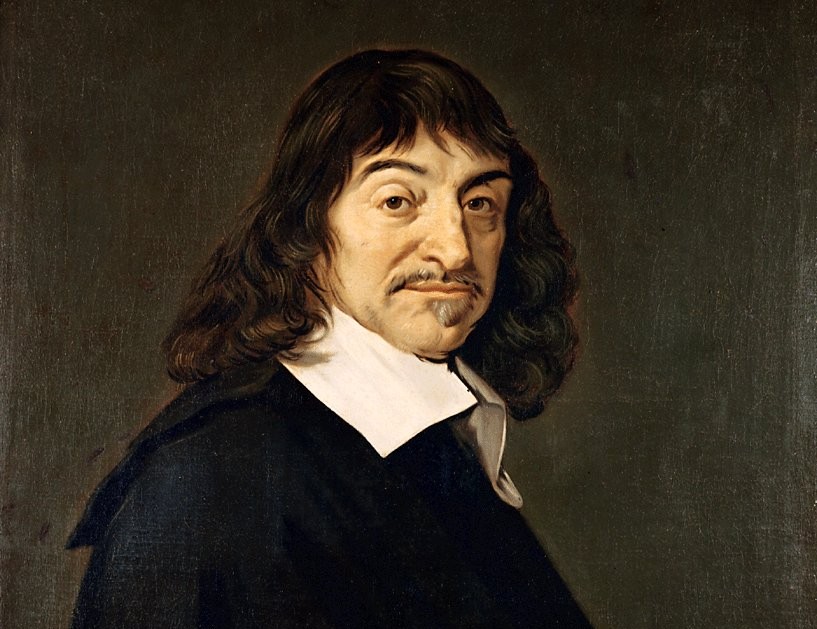
René Descartes Died of Pneumonia at 53
Descartes died of pneumonia in 1650 in Sweden, where he had been invited by Queen Christina to teach philosophy.
The climate there was extremely cold compared to what he was used to in France and the Netherlands.
His schedule also changed. He had to work late at night and wake up very early to teach, leaving him sleep‑deprived and physically weakened.
At that time, pneumonia had no effective treatment. When he caught it, he had to rely on natural remedies, but his body was not strong enough to recover.